
Supportive
Children learn best when AAC supports natural interaction
Research across 29 studies and 500+ participants shows that children develop stronger language when AAC is embedded in naturalistic routines like play, meals, and conversations. Copy Cat Mode mirrors aided modeling, guided practice, and naturalistic interaction, the strategies consistently shown to help children communicate more.
Read the research details
Research that supports this principle
AAC + Naturalistic Interaction Improves Language Outcomes
Pope, Light, & Laubscher (2024). Journal of Autism and Developmental Disorders. PubMed
This systematic review examined 29 studies involving over 500 participants to understand whether children with autism and minimal speech do better when AAC is combined with naturalistic, child-led teaching methods. The researchers found that children showed stronger expressive language when AAC was embedded within naturalistic routines like play, meals, and conversations. Children also generalized their skills better to new settings and conversation partners. The key finding: AAC did not replace natural interaction but enhanced it by giving children a reliable way to participate.
Communication Partner Training Improves AAC Use
Kent-Walsh, Murza, Malani, & Binger (2015). Augmentative and Alternative Communication. PubMed
This meta-analysis combined results from 17 high-quality studies to measure how much children's communication improves when adults around them receive training on how to support AAC use. The most effective strategies were aided modeling (showing how to use AAC while speaking), expectant pauses (waiting for the child to respond), and open-ended questions. Children communicated more, used longer utterances, and initiated more conversations when adults were trained. Effects were strongest for children under 12 years old.
AAC Modeling Works Across Ages and Diagnoses
Quinn, Kaiser, & Bhattarai (2023). Current Developmental Disorders Reports. Springer
This scoping review analyzed 29 studies involving 237 participants who were emergent communicators. The researchers examined whether aided AAC modeling (when communication partners point to symbols while speaking) helps children learn to communicate, regardless of their specific diagnosis or the AAC system used. The majority of studies reported positive outcomes, with children showing growth in vocabulary, spontaneous communication, and multi-symbol utterances across different ages, diagnoses, and types of AAC systems.
Simple
Reducing cognitive load helps children focus on expressing ideas
Cognitive Load Theory shows that cluttered, unpredictable interfaces overwhelm working memory and stop learning. ChirpBot redesigned its suggestion layout based on this research, moving from scattered multi-colored words to a calm, category-based ordering.
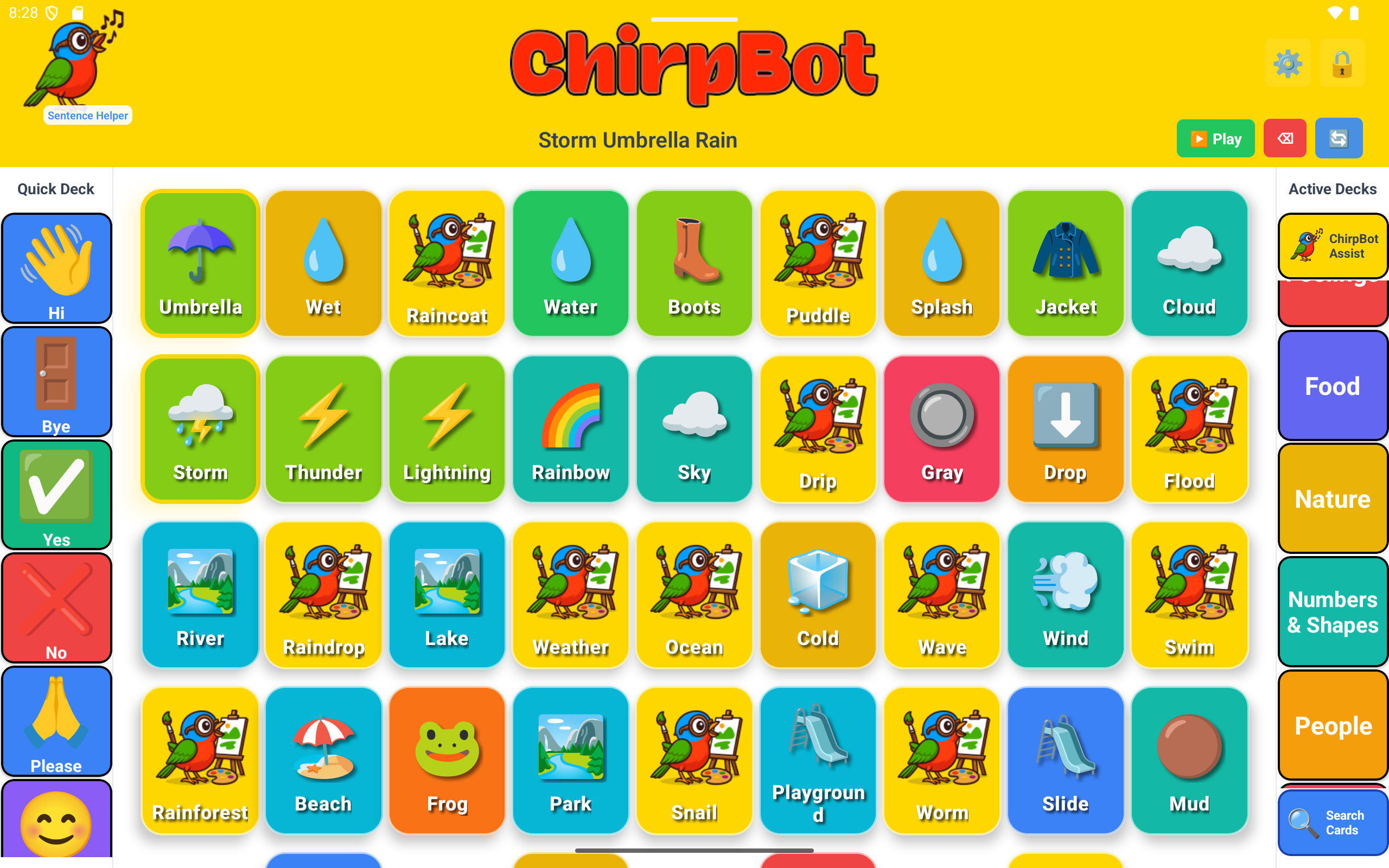
Before: Scattered Layout
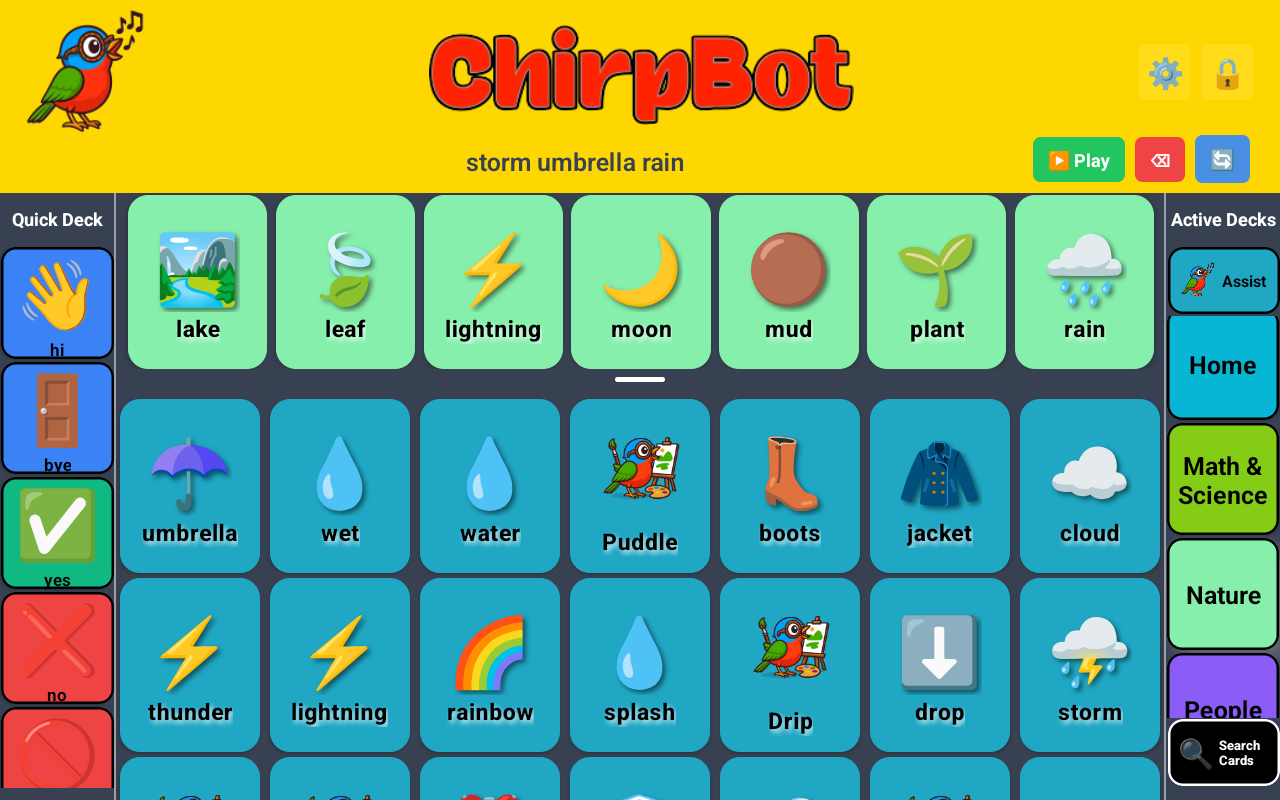
After: Predictable Pattern
Read the research details
Research that supports this principle
Cognitive Load Theory
Sweller (1988). Cognitive Science. Learning Theories
Cognitive Load Theory, developed by educational psychologist John Sweller, explains why our brains can only process a limited amount of new information at once. When learning materials are too complex, cluttered, or unpredictable, they overwhelm working memory and learning stops. The theory identifies three types of cognitive load: intrinsic (the difficulty built into the task itself), extraneous (unnecessary complexity added by poor design), and germane (the mental effort that actually builds knowledge). Good design minimizes extraneous load so learners can focus on what matters.
Practical Strategies for Reducing Cognitive Load
Structural Learning (2023). Cognitive Load Theory: A Teacher's Guide. View Article
This teacher-focused guide translates decades of cognitive load research into practical strategies. Key recommendations include reducing visual clutter, chunking information into smaller pieces, minimizing the number of steps required to complete a task, creating predictable routines and consistent layouts, and avoiding splitting attention between multiple sources of information. When materials are simple and predictable, children learn faster and remember more.
Interface Design and Learning
The Decision Lab (2023). Cognitive Load Theory. View Article
This behavioral science resource explains how cognitive load theory applies to real-world design. When interfaces reduce extraneous load, users learn more efficiently, make fewer errors, and retain information longer. Cluttered interfaces increase errors and slow learning, while predictable layouts allow users to build automatic responses. The article emphasizes that simplicity is not just about aesthetics. The best tools feel effortless because they match how the brain works.
Fun
Play activates the brain's learning systems
Neuroscience research shows that play activates neural networks for executive function, memory, and emotional regulation. Dopamine release during play enhances attention and motivation. When communication feels good, children want to do more of it.
Read the research details
Research that supports this principle
Neuroscience of Play
Liu et al. (2017). Neuroscience and Learning Through Play: A Review of the Evidence. LEGO Foundation. ResearchGate
This comprehensive review synthesized neuroscience research on how play affects brain development and learning. The researchers found that play activates neural networks responsible for executive function, memory, and emotional regulation. Dopamine release during play enhances attention, motivation, and learning. Play strengthens connections between brain regions involved in problem-solving and creativity. The emotional component of play is not separate from learning. It is essential to it.
Play-Based Learning Improves Outcomes
Whitebread et al. (2017). Learning Through Play: A Review of the Evidence. UNICEF/LEGO Foundation. PDF
This global evidence review examined research on play-based learning from early childhood through adolescence. Play-based approaches produce equal or better academic outcomes compared to direct instruction. Children in play-based programs show stronger social-emotional skills and self-regulation. Guided play, where adults support and extend children's exploration, is especially effective. The benefits of early play-based learning persist into later schooling.
Play Is Essential for Brain Development
National Institute for Play. Summary of Key Findings. Summary
The National Institute for Play has compiled decades of research demonstrating that play is not optional for healthy development. It is a biological necessity. Over 70% of cortical brain development occurs by age three, shaped significantly by play experiences. Play builds emotional intelligence and self-regulation through safe exploration. Physical and social play wire neural circuits for attention, flexibility, and problem-solving. As the researchers state, humans are "built to play, and built through play."
AI + AAC
AI should support the child's voice, not replace it
A peer-reviewed CHI study found that AAC users prefer AI that supports their voice rather than replacing it. They valued transparency and control over suggestions. ChirpBot's AI features are always optional and always user-controlled.
Feature Example: Optional, Transparent Suggestions
ChirpBot's AI suggestions are always optional and always user-controlled. The child remains the author of every message. AI helps reduce effort and increase expression, while ensuring the child's voice stays at the center of every interaction.
Read the research details
Research that supports this principle
How AI Helps or Hinders AAC Users
Valencia et al. (2023). ACM Conference on Human Factors in Computing Systems (CHI). Google Research
This peer-reviewed study explored how large language models can help or hinder people who use AAC. The researchers interviewed AAC users and tested AI-generated phrase suggestions to understand how AI changes the communication process. They found that AI suggestions can reduce effort and increase speed, and can help users express more complex ideas than they could type manually. However, AI can also shift control away from the user if suggestions feel too automated or do not match the user's intent. Users preferred AI that supported their voice rather than replacing it, and they valued transparency and control over suggestions.
Motor Planning, Visual Search, and Language Learning
What cognitive science tells us about how humans actually find things
A common belief in AAC is that symbols must stay in fixed positions so users can build automatic motor patterns. Motor learning is real, and consistent layouts can help some learners access known vocabulary more efficiently. But the broader cognitive science research paints a more nuanced picture, suggesting that exploration, recognition, and meaningful use may matter far more than memorized locations.
How Children Actually Learn to Find Things
A common belief in AAC is that symbols must stay in fixed positions so users can build "motor plans," meaning automatic physical movements to find words without looking. Motor learning is real, and consistent layouts can help some learners access known vocabulary more efficiently. But this idea has been elevated far beyond what the evidence supports, often treated as a prerequisite for language development itself.
The broader cognitive science research tells a more nuanced story, one that suggests exploration, recognition, and meaningful use may matter far more than memorized locations.
What This Means for ChirpBot's Design
Motor planning is one valid tool in the AAC toolbox. It can support efficient access to vocabulary for some learners. But for children who are still learning to communicate, especially those with motor planning challenges common in autism, exploration and meaning come first.
ChirpBot is designed around the principles that developmental science tells us drive language acquisition: recognition, exploration, meaningful modeling, emotional connection, and repetition in context. Not because motor planning is wrong, but because language development requires more than knowing where symbols are.
Read the research details
Research that informs this principle
Even Expert Typists Don't Know Where the Keys Are
Snyder, K.M., Ashitaka, Y., Shimada, H., Ulrich, J.E., & Logan, G.D. (2014). What skilled typists don't know about the QWERTY keyboard. Attention, Perception, & Psychophysics, 76(1), 162-171. Springer
Researchers at Vanderbilt University asked skilled typists, people averaging 72 words per minute with 94% accuracy, to fill in the positions of letters on a blank keyboard. They could correctly place only about 15 out of 26 keys. Even after learning an entirely new keyboard layout (Dvorak), their spatial recall did not improve. The researchers concluded that typing speed comes from procedural memory (the body learning through doing), not from conscious knowledge of where keys are located. As lead researcher Gordon Logan noted: "It appears that not only don't we know much about what we are doing, but we can't know it because we don't consciously learn how to do it in the first place."
Most People Type Using Visual Search, Not Motor Plans
Logan, G.D., Ulrich, J.E., & Lindsey, D.R.B. (2016). Different (key)strokes for different folks: How standard and nonstandard typists balance Fitts' law and Hick's law. Journal of Experimental Psychology: Human Perception and Performance, 42(12), 2084-2102. Vanderbilt News
A follow-up study from the same Vanderbilt lab found that the vast majority of modern typists are self-taught and use nonstandard, visually guided strategies rather than memorized finger positions. When researchers tested 48 typists, they discovered that even among people who believed they were touch typists, more than half actually relied on looking at the keyboard. The key finding: these visual typists were nearly as fast and accurate as trained touch typists, as long as they could see the keys. Visual search is not a deficit or a failure to learn. It is a normal, efficient human strategy used by most people, most of the time.
Consistent Placement Helps Motor Access, But the Evidence Base Is Small
Thistle, J.J., Holmes, S.A., Horn, M.M., & Reum, A.M. (2018). Consistent symbol location affects motor learning in preschoolers without disabilities. American Journal of Speech-Language Pathology, 27(3), 1010-1017. PubMed
This study tested 24 preschoolers without disabilities and found that consistent symbol placement led to faster response times by the fifth session compared to variable placement. This is a meaningful finding: it confirms that consistent layouts can genuinely help learners access known vocabulary more quickly, which matters for communication speed and fluency. What the study measured was motor efficiency, how fast children could locate a target they already knew. It was not designed to measure whether consistent placement affects language acquisition, vocabulary growth, or overall communication outcomes. Those are different questions, and they remain open. Both things can be true: consistent layouts support efficient access, and language learning is driven by other factors.
Language Acquisition Is Driven by Meaning, Not Spatial Memory
Pope, Light, & Laubscher (2024). Journal of Autism and Developmental Disorders. PubMed | Kent-Walsh et al. (2015). PubMed
Decades of developmental research, including the systematic reviews cited elsewhere on this page, consistently show that language acquisition is driven by meaningful interaction, emotional connection, aided modeling, and repetition in natural contexts. Children learn words that matter to them, in moments that matter to them, from people who matter to them. Motor efficiency may help a child access known vocabulary faster, but it is not what drives the learning of new vocabulary in the first place. These are different processes, and conflating them has led to an overemphasis on spatial consistency at the expense of the factors that actually build language.
Our Commitment
ChirpBot is grounded in universal communication principles and shaped by the diverse needs of families around the world. We refine the app through:
- Real-world use in homes and classrooms
- Feedback from families, educators, and clinicians
- Ongoing observation of how children communicate
- Iterative design informed by research
Our goal is simple: help every child communicate more easily, more joyfully, and in ways that fit their world.
Ready to See Research in Action?
ChirpBot brings these principles to life in an app designed for real families and classrooms.